
Summary:
Modern leadership often feels like a “silent struggle,” where high-stakes decision-making paves the way for psychologically isolated leaders. In 2026, the “lone wolf” model is a liability; data shows mentored leaders are twice as likely to sustain long-term success. Through the “Mirror Effect,” mentors act as an external nervous system, helping executives downshift from reactive stress to logical strategy. Rather than providing ready-made answers, mentors break the “echo-chamber” syndrome by offering 360-degree awareness and a safe space for vulnerability. Ultimately, transitioning from isolation to insight via professional mentoring frameworks is no longer a perk; it is the essential infrastructure for modern executive resilience.
Introduction
Do you know what is the biggest paradox of being a leader? You can be surrounded by hundreds of people, yet you might feel completely alone while making decisions. In today’s fast-moving, constantly shifting world, the isolation that leaders feel can quietly become a risk, and that’s exactly where mentoring steps in to help leaders bridge the gap between isolation and collaboration. If you have ever wondered what is mentoring or why it matters, this blog will show you why having a mentor is more important now than ever. Ready for the big reveal? Read on!
The Silent Struggle of Modern Leadership
From managing hybrid teams to making high-stakes calls under uncertainty, leaders are constantly operating in gray zones. However, many executives at the top hesitate to admit that they need guidance. Think about it, would a CEO openly say that they are not sure about something? Rarely!
This uncertainty creates a dangerous loop because the more senior you become, the less feedbacks you receive. Colleagues may filter their opinions, teams may avoid challenging you, and over time, this leads to isolation, even for the most capable leaders.
Solitude v/s Loneliness: The High-Stakes Distinction
For leaders, solitude is the sanctuary of the depths, where business figureheads strategize and find their flow. However, loneliness is a psychological tax and a feeling that a leader must maintain a “bulletproof” persona at all times.
When, as a leader, you are isolated, the decision-making cycle suffers from the “echo-chamber” syndrome. People start filtering the truth before it reaches you. They “soften” the bad news or nod at your ideas because of your pay grade, and without a mentor, you lose your most valuable asset, i.e., the ability to see the “jagged edges” of your own strategy.
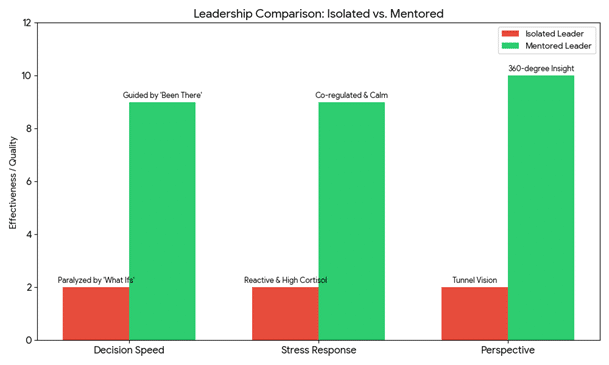
A mentor can act as a Confidant-at-large, or the only person to whom you can say, “I have no idea what I am doing wrong,” without risking your job or crashing the company’s stock price. To make things further clear, here’s a table on the impact of isolation on executive function with and without a mentor.
Co-regulated, proactive
| Factor | Isolated Leader | Mentored Leader |
| Risk assessment | Driven by fear or ego | Balanced by experience |
| Stress response | ||
| Perspective | Tunnel vision | 360-degree awareness |
| Sustainability | High burnout risk | Long-term resilience |
The Neuroscience of the “Mirror Effect”
Wondering why a conversation with a seasoned mentor feels so grounding? Well, it’s not just the advice; it’s more about the biology. The “Mirror Effect” is a theory that suggests that through mirror neurons, leaders subconsciously adopt the temperament of their mentors.
When you sit across from someone who has weathered three recessions, your brain engages in co-regulation. Essentially, the mentor acts as an external nervous system, and in high-pressure environments, their calm presence signals your brain to downshift from the reactive amygdala back to the prefrontal cortex, which is the seat of executive logic.
Solving the Systematic Gap
Modern organizations often struggle to move beyond informal chats to orchestrated growth. This gap is exactly what the International Mentoring Center (IMC) aims to close. As they put it: “We saw talented people get stuck because they didn’t have the right guidance… That’s why we built a platform where mentorship is accessible to individuals, organizations and institutions worldwide.” (Source) As defined by the IMC, “Mentoring is a collaborative, dialogic and reflective learning relationship with mutual learning agreements and shared responsibilities to facilitate the personal and professional development of the individual or teams to create awareness, increase choices and develop capabilities.” (Source) To move from isolation to a culture of insight, mentors help to address the practical roadblocks, including the following:
| Challenge | Solution |
| Scaling globally | Mentors push leaders to embrace the new shift, and automate matching and tracking for hybrid, cross-border teams |
| Low engagement | Using “nudges” and structured mentoring journeys |
| Measuring impact | Leveraging analytics to track leadership growth, retention, and ROI |
| Lack of diversity | Inclusive mentoring pathways help to break down the archaic leadership silos |
Why Now? The Modern Mandate
In 2026, the complexity of leadership is evolving faster than human evolution. Between the integration of AI, remote culture fragmentation, and global volatility, the “lone wolf” model of leadership has become outmoded.
Statistics show that 70% of mentored small business owners survive for five years or more, which is double the rate of those who go for it alone. (Source) Especially in the corporate world, the numbers are even starker, and today, mentorship isn’t a “nice-to-have” perk; it’s the infrastructure of modern executive success. In fact, mentoring can turn your isolation into a vantage point and your uncertainty into a strategy.
What Mentors Actually Do (And Don’t Do)
Let’s clear a common misconception that most people have. Mentors don’t have all the answers. Instead, they help you ask better questions. Here’s a quick look:
| What Mentors Do | What Mentors Don’t Do |
| Challenge your thinking | Give ready-made solutions |
| Offer perspective | Control your decisions |
| Share experiences | Impose their path |
| Hold you accountable | Micromanage your actions |
This dynamic is formidable because it keeps you in control while expanding your awareness.
The Verdict: Leadership Doesn’t Have to Be Lonely
The “Lonely at the Top” trope doesn’t have to be your reality as a leader because true leadership isn’t a solo trek; it’s rather a collaborative journey. By inviting a mentor into your professional life, you aren’t just gaining an advisor; you will be gaining a competitive advantage that no software or market analysis tool can replicate- you get human wisdom.
Ready to break the silence of the summit? Don’t let your perspective be limited by the walls of your own office. Opt for mentoring frameworks and transition from the vacuum of isolation to the clarity of insight. Need more information or want to schedule a session with the industry experts to understand the difference between mentoring v/s coaching? Connect with our team at the International Mentoring Center today and discover how mentorship can redefine your future.

MENTORING  JUNE 10, 2024

MENTORING JUNE 10, 2024

MENTORING JUNE 10, 2024